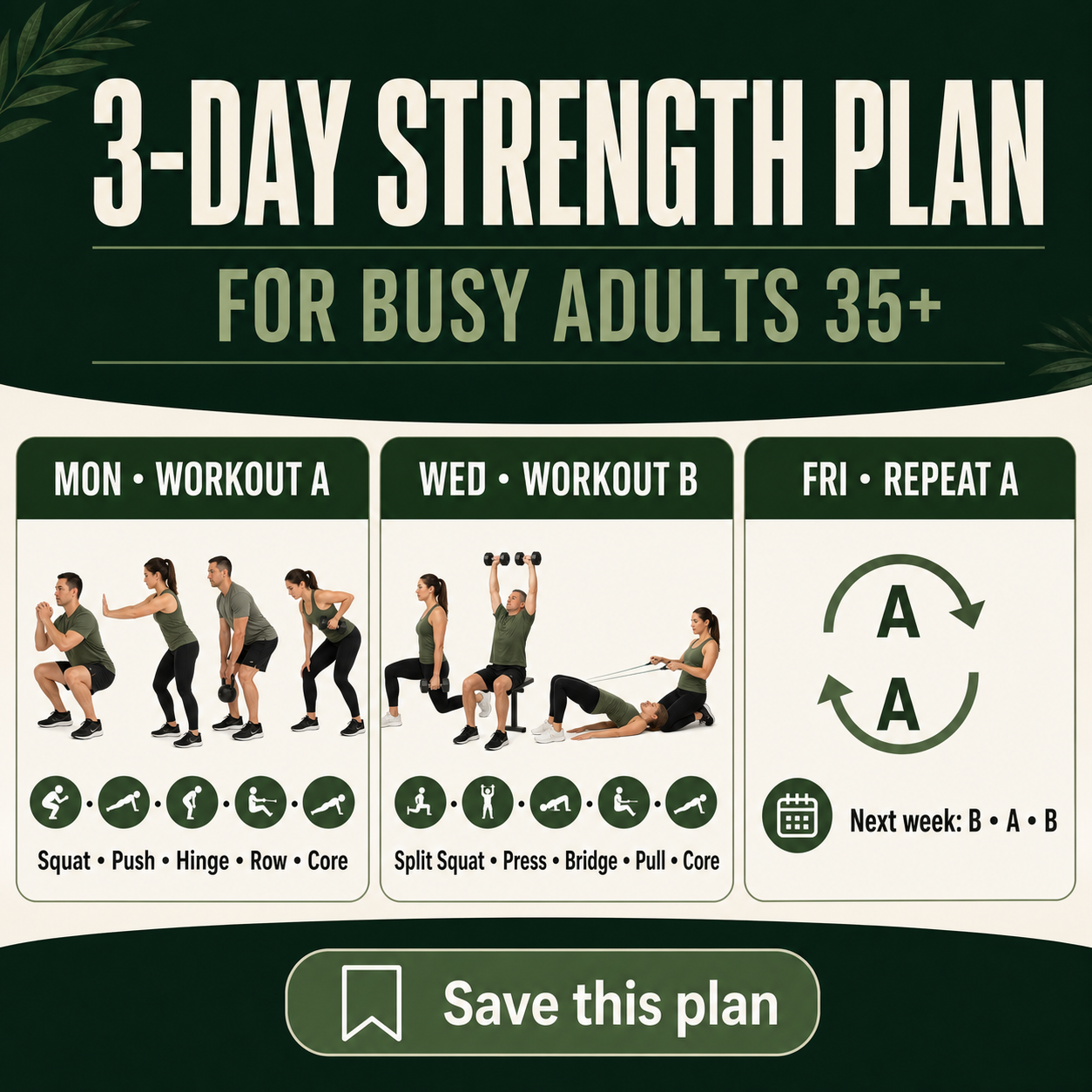
3-Day Strength Workout Plan for Busy Adults Over 35
If your week is busy, a simple plan you can repeat is more useful than a complicated programme you abandon. This three-day strength workout plan is designed for adults over 35 who want to become stronger, support healthy body composition and train efficiently at home or in a gym.
Each session takes roughly 35–50 minutes. You will train the main movement patterns, leave recovery days between sessions and progress gradually. This is not a crash programme or a promise of instant results—it is a practical framework for building consistency.
Why train strength three days a week?
The NHS recommends strengthening activities that work all the major muscle groups on at least two days each week. Three full-body sessions give you regular practice while still allowing rest between workouts. If three days is too much at first, begin with two and add the third when recovery feels comfortable.
Your weekly schedule
- Monday: Workout A
- Tuesday: Easy walk or rest
- Wednesday: Workout B
- Thursday: Easy walk or rest
- Friday: Workout A
- Weekend: Light activity and recovery
The following week, use B–A–B. That keeps both workouts balanced over time. The exact days do not matter; aim to leave at least one recovery day between strength sessions.
How hard should the sets feel?
For most exercises, perform 2–3 sets of 8–12 controlled repetitions. Choose a resistance that makes the final repetitions challenging while your technique remains steady. Finish each set feeling that you could probably complete another two or three good repetitions.
Rest for 60–120 seconds between sets. Longer rest is fine after demanding movements such as squats or deadlifts. Quality matters more than rushing.
Warm-up: 5–8 minutes
Start with easy movement that raises your temperature: brisk walking, cycling or marching on the spot. Then practise one light set of the first two exercises. A warm-up should prepare you, not exhaust you.
Workout A
- Squat pattern: goblet squat, bodyweight squat or leg press — 2–3 sets of 8–12.
- Horizontal push: press-up, elevated press-up or dumbbell chest press — 2–3 sets of 8–12.
- Hip hinge: dumbbell Romanian deadlift, kettlebell deadlift or light barbell deadlift — 2–3 sets of 8–12.
- Row: resistance-band row, one-arm dumbbell row or seated cable row — 2–3 sets of 8–12.
- Carry or core: farmer carry for 30–45 seconds, or a plank for 20–40 seconds — 2–3 rounds.
Workout B
- Single-leg pattern: supported split squat, reverse lunge or step-up — 2–3 sets of 8–12 per side.
- Vertical or inclined push: dumbbell shoulder press, machine press or elevated press-up — 2–3 sets of 8–12.
- Glute-focused movement: glute bridge, hip thrust or cable pull-through — 2–3 sets of 8–12.
- Pull: band pulldown, lat pulldown or assisted pull-up — 2–3 sets of 8–12.
- Core stability: dead bug or side plank — 2–3 controlled rounds.
Home and gym substitutions
You do not need a perfect equipment setup. At home, a resistance band and one pair of dumbbells can cover most of the plan. If the weights are light, slow the lowering phase, pause in the hardest position or add repetitions within a sensible range. In a gym, machines are completely acceptable and can make it easier to adjust resistance.
Choose versions that feel stable and pain-free. The movement pattern is more important than using a particular exercise.
How to progress without overcomplicating it
Start with two sets per exercise for the first two weeks. When you can complete the top of the repetition range with consistent form, add a small amount of resistance at the next session. If you cannot increase the weight in small steps, add one repetition per set until you reach 12, then increase the load and return to 8–9 repetitions.
Keep a simple note of the exercise, weight and repetitions. Progress will not be perfectly linear, especially during stressful weeks. Repeating the session at the same level is still useful training.
The minimum-day fallback
On a very busy day, do one good set of each movement instead of skipping the session. That can take 15–20 minutes and protects the habit. Return to your normal volume next time; there is no need to “make up” missed work.
Strength training and fat loss
Strength work can help you maintain or build physical capacity, but exercise is only one part of a sustainable fat-loss approach. Regular meals, adequate protein and fibre, everyday movement, sleep and a manageable calorie intake all matter. Avoid aggressive restriction that leaves you exhausted and makes training difficult.
New to structured training? Start with our realistic 28-day fitness challenge for beginners, then use this three-day plan as your ongoing weekly structure.
Prefer to have the workouts, home and gym alternatives, progression rules and printable trackers arranged for you? Explore the 28-Day Fitness Plan for Beginners.
Safety and recovery
Build up gradually and allow time to recover. Stop an exercise if it causes sharp or worsening pain. If you have a health condition, an injury, are pregnant, or have been inactive for a long time, speak with a qualified healthcare or exercise professional before starting.
Reliable guidance
- NHS physical activity guidelines for adults aged 19 to 64
- NHS guidance on improving strength and flexibility
This article is for general education and is not personalised medical or exercise advice.

Leave a Reply